Divident Investing Themes
This newsletter will explore some of the top industries and themes to explore if you are searching for high-yielding dividend stocks.

Dividend investing has been a solid strategy for many decades, as dividend income has been a strong driver of the S&P 500’s returns. As risks potentially pick up in 2026, focusing on high-yielding stocks in a defensive theme may be a solid strategy to lower volatility and earn safer returns.
In today’s edition, we explore some of the top themes, industries, and markets one can consider if they are searching for higher dividend-yielding stocks.
Dividend Investing Appeals
Dividend investing is a solid investing strategy for risk-averse investors, and this strategy has proven to be very effective over the past few decades. WisdomTree recently noted that dividends have contributed to around 30% of the gains of the S&P 500.
This newsletter will explore some of the top industries and themes to explore if you are searching for high-yielding dividend stocks.
Telecommunications Stocks
Telecommunications stocks can be an excellent target for dividend investors, as they typically have stable performance and offer above-average dividend yields.
Another key appeal of these stocks is that many of them have had very favorable earnings growth, yet have still flown under the radar of many people. The latest earnings growth rate for the Vanguard Communications Services ETF was over 20%, which is notably higher than that of the tech-dominated S&P 500.
Some of the most dominant players in the industry are trading at reasonable valuations and have a higher dividend yield than leading S&P stocks. Leading telecom players like AT&T, Vodafone, and Verizon have a dividend yield that exceeds 3%.
Another interesting source of growth to consider is global telecom stocks, which should continue to have moderate growth in the upcoming years.
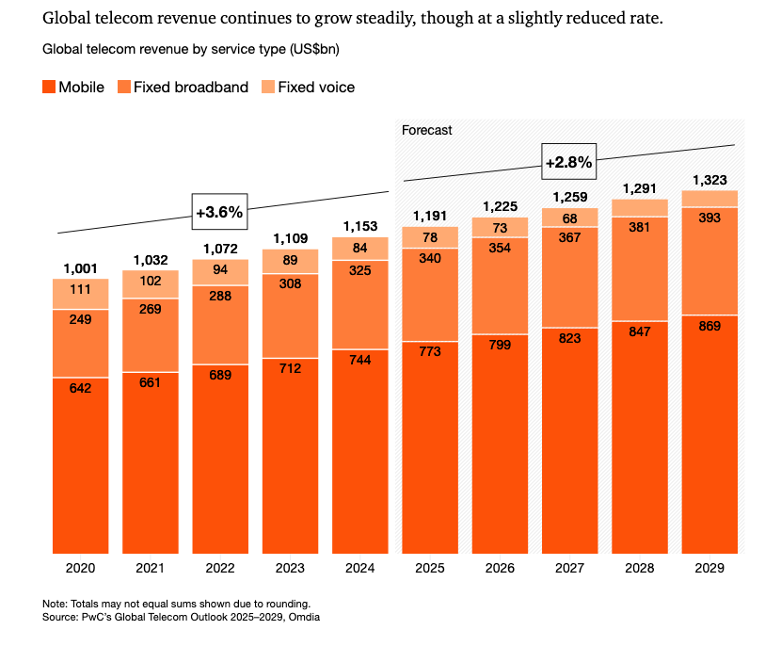
Some notable emerging market telecom players include Telefonica Brazil, Turkcell, Telkom Indonesia, and Telecom Argentina. Many of these names still have reasonable yields and have also delivered double-digit gains in the past year. Emerging market stocks like this can be a great portfolio diversifier by exposing your portfolio to global growth.
Focusing on a combination of domestic and international high-yielding plays can be a great strategy to outperform this year, as the overall yield in major US telecommunications indices has fallen below 2%.
Real Estate Investment Trusts ( REITs)
A real estate investment trust is a type of company that owns and operates income-producing real estate projects. Many of these REITs are publicly listed on stock exchanges, allowing investors to gain exposure to large-scale real estate projects without having to actively manage them.
REITs target a variety of areas, including office real estate, retail real estate, healthcare real estate, and residential real estate. One of the other main appeals of REITs is that many of these products offer above-average dividend yields. As of the end of 2025, REITs had an average dividend yield of around 4%, notably higher than that of the S&P 500.
As more companies push for employees to return to the office, now could be a good time to take advantage of the yield in commercial REITs. The VanEck Office and Commercial REIT ETF provides exposure to a basket of commercial real estate properties, and currently yields around 4.5%.
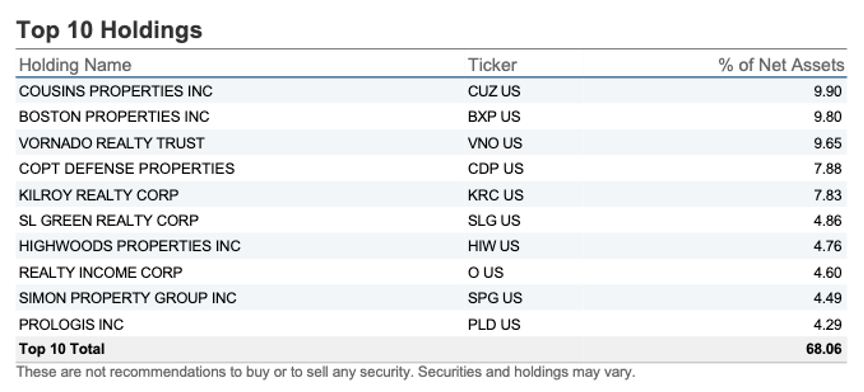
Healthcare real estate is another high-yielding and conservative area to consider. Healthcare rental income is non-discretionary, which can allow healthcare real estate projects to perform well during poor economic cycles. Some higher-yielding REITs include Healthpeak Properties, Medical Properties Trust, and Caretrust REIT.
For those who are unsure which specific theme they want to target, the iShares Core US REIT ETF is an option to consider, which invests in a basket of real estate companies in a variety of real estate themes.
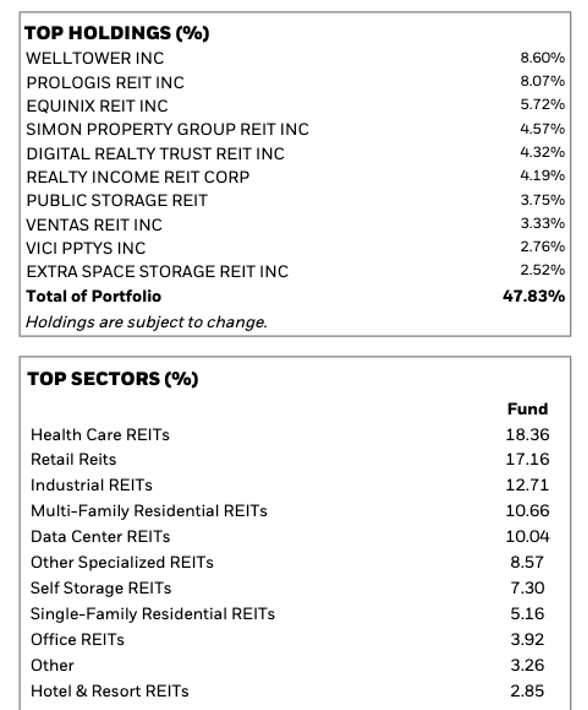
REITs are a great way to diversify your portfolio and gain exposure to themes in the United States that are able to generate sustainable cash flow. These investment vehicles could be solid portfolio diversifiers in 2026.
Utility Stocks
Utility stocks offer reasonable dividend yields and are often very appealing to investors during risky economic cycles, as these companies tend to have more stable performance relative to other growth sectors.
Many of these stocks deliver consistent financial performance, targeting modest earnings growth of around 5-8% per annum. While this lacklustre growth may be overlooked during hype cycles, where growth stocks dominate, these stocks can come into increased focus when market tensions rise.
For those willing to ignore the market noise, investing in a basket of utility stocks can be a passive strategy to earn a 3-5% yield and wait out the market for better entry points in other sectors.
Some high yielding utilities stocks to check out include Duke Energy, Northwestern Energy Group, and Edison International. There are also several utilities dedicated to ETFs, but the yield for many of these products is below 3%. Select stock picking can be a better strategy for this specific theme.
Exchange Traded Funds
For most investors, exchange-traded funds can be the simplest option. There are many ETFs that focus on identifying high dividend yield stocks while sticking to certain thematic investments. For example, these ETFs may focus on opportunities in international and emerging markets, or focus exclusively on small and mid-cap stocks that are undercovered in the market.
ETFs like the Global X Superdividend US ETF and the Invesco S&P SmallCap High Dividend Low Volatility ETF are interesting products to consider. Investing in broad-based ETFs like this can help investors offset some of the sector-specific volatility and further diversify their portfolios.
As mentioned previously, many sector ETFs, like the telecommunications industry ETF, contain constituents with yields that may be double or more than the average of the ETF. If you are willing to have concentrated exposure to individual companies, it could be worthwhile to take a look at the top 10-20 holdings of major ETFs and select companies that stand out based on their yield and historical financial performance.